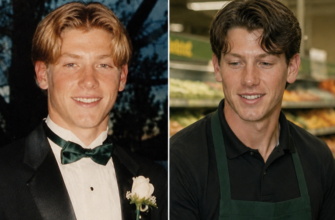
Der König des Betons
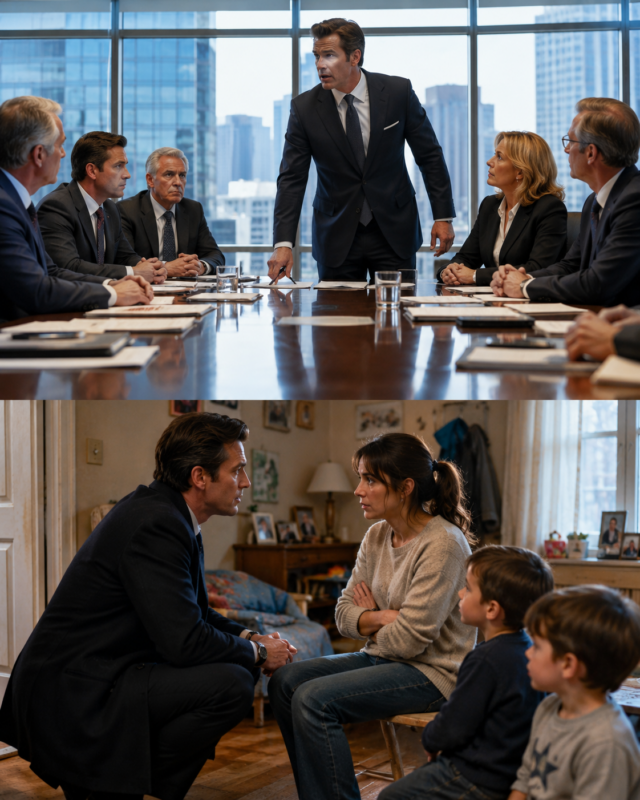
Nathan Harrison hatte in Dubai, New York und London milliardenschwere Deals abgeschlossen, ohne mit der Wimper zu zucken.
In den Vereinigten Staaten nannte man ihn den „König des Betons“.
Wo immer er seinen Namen unter einen Vertrag setzte, entstanden Luxustürme. Einkaufszentren wuchsen aus leeren Grundstücken empor. Private Wohnanlagen entstanden hinter bewachten Toren, wo polierte SUVs über makellose Straßen rollten und Brunnen vor Marmoreingängen tanzten.
Nathan hatte sein Imperium aus Ehrgeiz, Timing und kalter Disziplin aufgebaut.
Er wusste, wie man Verträge liest.
Er wusste, wie man Investoren liest.
Er wusste, wie man einen Raum betritt und mächtige Männer zum Zuhören bringt.
Doch an einem ruhigen Freitagnachmittag, in einer kleinen Bäckerei im Norden Chicagos, sah Nathan Harrison etwas, auf das ihn kein Geschäftsdeal vorbereitet hatte.
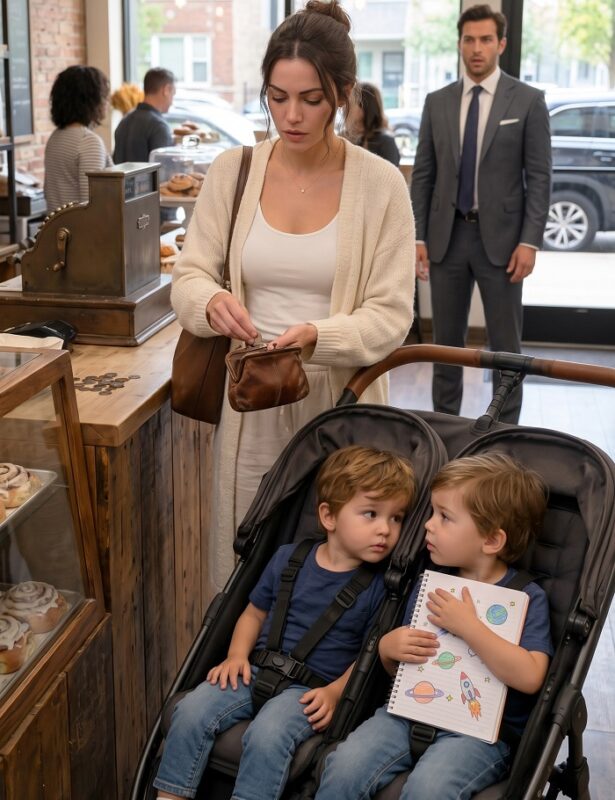
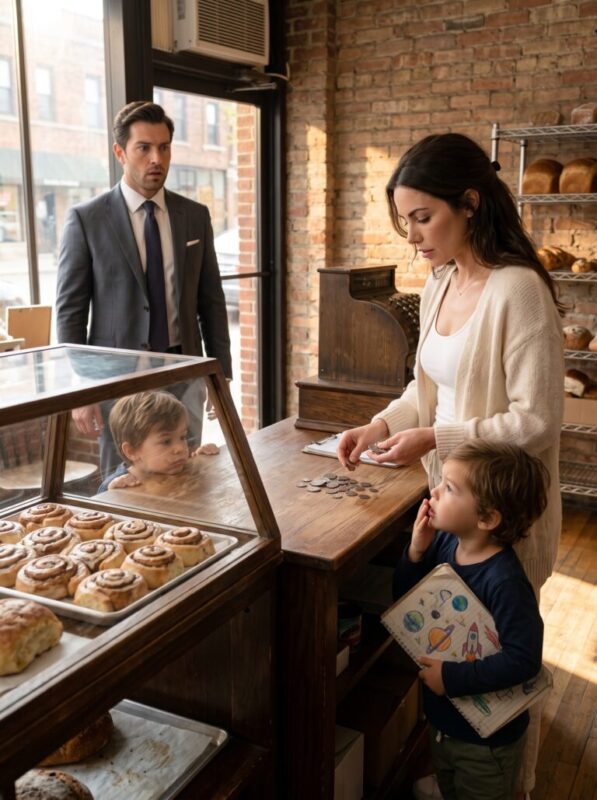
Seine Ex-Frau Emma Parker stand an der Kasse und zählte Münzen auf dem Tresen.
Neben ihr standen zwei identische kleine Jungen, etwa vier Jahre alt.
Der eine starrte durch die Glasscheibe auf Zimtschnecken, als wären sie ein Schatz. Der andere hielt ein abgenutztes Notizbuch fest umklammert, gefüllt mit Zeichnungen von Planeten, Sternen und Raketen.
„Mama“, flüsterte der ruhigere Junge, „wenn nicht genug Geld da ist, brauche ich kein Brot.“
Emma lächelte mit derselben trotzigen Würde, an die sich Nathan nur zu gut erinnerte.
„Es reicht, Liebling. Wir müssen nur sorgfältig zählen.“
Nathan hörte auf zu atmen.
Das konnte nicht sein.
Emma hatte ihn noch nicht gesehen.
Ihr Haar war zu einem schlichten Pferdeschwanz gebunden. Sie trug einen alten beigen Mantel, verblasste Jeans und Schuhe, die eindeutig zu viele Winter überstanden hatten. In ihren Augen lag Erschöpfung, aber keine Niederlage.
Sie sah nicht aus wie die Frau, die einst bei Charity-Galas in Designerroben neben ihm stand, während Kameras blitzten.
Sie sah aus wie eine Mutter, die gelernt hatte, allein zu überleben.
Der Bäcker, Mr. Russo, schob leise zwei zusätzliche Teilchen in die Papiertüte.
„Nehmen Sie sie ruhig“, sagte er. „Freitagsangebot.“
Emma schüttelte den Kopf.
„Nein, Mr. Russo, ich kann das nicht.“
„Sie verletzen meine Gefühle, wenn Sie ablehnen.“
Die Jungen jubelten leise.
Nathan trat einen Schritt zurück, bevor Emma sich umdrehen konnte.
Dann verließ er die Bäckerei, sein Herz hämmerte, als hätte er gerade alles verloren.
Die Frau, die er zurückgelassen hatte
Draußen stand Nathan neben seinem schwarzen Wagen und konnte sich nicht bewegen.
Der Verkehr Chicagos rauschte hinter ihm vorbei. Hupen ertönten. Menschen eilten mit Kaffeebechern und Einkaufstaschen über den Gehweg. Doch Nathan sah nur Emmas Hände, die Münzen zählten.
Er erinnerte sich an diese Hände.
Sie hatten seine gehalten, als er niemand war.
Vor den Penthousewohnungen.
Vor den Schlagzeilen.
Bevor Investoren ihn ein Genie nannten.
Emma hatte ihn geheiratet, als er nur ein Mann mit großen Träumen und einer billigen Wohnung war. Sie hatte Doppelschichten in einer Klinik gearbeitet, während er Bauaufträge jagte, die fast immer scheiterten.
Sie hatte an ihn geglaubt, bevor es irgendjemand sonst tat.
Und dann kam der Erfolg.
Zuerst langsam. Dann plötzlich.
Mit dem Erfolg kamen Partys, Reisen, Druck – und Menschen, die Nathan zuflüsterten, Emma sei zu einfach für die Welt, in die er eintrete.
Seine Mutter hatte Emma nie gemocht.
„Sie gehört nicht an deine Seite“, hatte Margaret Harrison einst gesagt. „Ein Mann wie du braucht eine Frau, die Macht versteht.“
Nathan war töricht genug gewesen, zuzuhören.
Die Ehe zerbrach nach drei Jahren.
Es gab Streit. Missverständnisse. Lange Schweigen.
Dann kam die Scheidung.
Emma ging leise.
Nathan stürzte sich in Arbeit und redete sich ein, er habe das Richtige getan.
Doch nun, Jahre später, hatte er sie gesehen – wie sie Münzen zählte, während zwei kleine Jungen neben ihr standen.
Zwei Jungen mit seinem dunklen Haar.
Seinen grauen Augen.
Seinem ernsten Blick.
Der Wahrheit in einer Akte
In jener Nacht, in seinem gläsernen Büro mit Blick über Chicago, rief Nathan seine langjährige Assistentin an.
„Ich brauche Informationen über Emma Parker.“
„Ihre Ex-Frau?“, fragte sie.
„Ja.“
„Wie viele Informationen?“
Nathan blickte auf die Stadt, die er mit aufgebaut hatte.
„Alles.“
Die Wahrheit in einer Akte
Am Montagmorgen lag ein Ordner auf seinem Schreibtisch.
Er starrte ihn fast eine Stunde lang an, bevor er ihn öffnete.
Darin standen einfache Fakten.
Emma Parker, 34 Jahre alt.
Teilzeit-Mitarbeiterin in einer medizinischen Verwaltung.
Teilzeit-Reinigungskraft am Wochenende.
Adresse: kleine Wohnung über einer alten Wäscherei.
Kinder: Zwillingsjungen, Oliver und Owen Parker.
Alter: vier Jahre.
Nathan ballte die Hände.
Als Vater eingetragen: nicht angegeben.
Er las die Zeile erneut.
Nicht angegeben.
Seine Brust wurde schwer.
Keine Skandale. Kein Vermögen. Kein neuer Ehemann.
Nur eine Frau, die zwei Jobs arbeitete und ihre Kinder allein großzog.
Dann fand Nathan einen Krankenhausbericht.
Die Jungen waren sieben Monate nach der rechtskräftigen Scheidung geboren worden.
Sieben Monate.
Nathan lehnte sich zurück.
Ein Deal für einen König
In derselben Woche sollte Nathan den größten Deal seiner Karriere abschließen.
Ein riesiges Luxus-Entwicklungsprojekt am Chicago River. Hochhäuser, private Clubs, Designerläden, eine exklusive Marina.
Die Medien nannten es bereits „die Krönung urbanen Luxus“.
Wenn Nathan unterschrieb, würde sein Unternehmen unangreifbar werden.
Doch ein Problem blieb.
Das Gelände umfasste auch ältere Wohnblocks – darunter das Gebäude, in dem Emma lebte.
Emmas Tür
Zwei Tage später stand Nathan vor ihrer Wohnung über der Wäscherei.
Zum ersten Mal seit Jahren war er nervös.
Er klopfte.
Emma öffnete.
„Nathan?“
„Hallo, Emma.“
„Was machst du hier?“
„Ich muss mit dir reden.“
„Wir haben nichts zu reden.“
Aus der Wohnung kam eine kleine Stimme: „Mama, wer ist das?“
Nathan erstarrte.
Emma schloss die Tür hinter sich.
„Warum jetzt?“, fragte sie.
„Ich habe dich in der Bäckerei gesehen.“
„Hast du mich verfolgt?“
„Nein.“
„Warum dann?“
Nathan sah sie an.
„Sind sie meine?“
Stille.
„Ja“, flüsterte Emma.
Nathan griff das Geländer.
„Warum hast du es mir nicht gesagt?“
Emma lachte bitter.
„Ich habe es versucht.“
„Ich kam zu deinem Büro. Ich habe angerufen. Ich habe Briefe geschickt. Deine Mutter hat sie ungeöffnet zurückgeschickt.“
Nathan wurde blass.
„Meine Mutter?“
„Sie sagte, ich würde dich nur manipulieren wollen.“
Nathan brachte kein Wort heraus.
Emma fuhr fort:
„Ich habe sie allein großgezogen. Ich habe sie durch Fieber begleitet. Ich habe jede Frage allein beantwortet. Ich habe ihnen gesagt, ihr Vater sei weit weg – weil ich ihnen nicht das Gefühl geben wollte, unerwünscht zu sein.“
Nathan hatte Tränen in den Augen.
„Ich wusste es nicht.“
„Aber du hast dich entschieden, es nicht zu wissen“, sagte sie.
Und darauf hatte er keine Antwort.
Two Little Boys
The apartment door opened slightly.
Two identical faces peeked out.
“Mom?” one boy asked.
Emma quickly wiped her eyes. “It’s okay, Oliver.”
The other boy stared up at Nathan. “Are you the landlord?”
Nathan almost laughed, but the sound caught in his throat.
“No,” he said gently. “I’m Nathan.”
The boy with the notebook stepped forward. “I’m Owen. I draw rockets.”
Nathan crouched down to their level.
“I heard you like space.”
Owen’s eyes lit up. “Do you know how rockets work?”
“A little.”
Oliver studied Nathan carefully. “Do you like cinnamon rolls?”
Nathan smiled faintly, with a sadness underneath.
“I think I do now.”
Emma looked overwhelmed.
The boys invited Nathan inside with the effortless kindness of children who had not yet learned adult boundaries or pain.
The apartment was small but warm. Drawings were taped to the walls, secondhand books were neatly stacked by the window, and two small beds sat under matching blue blankets.
Nathan noticed what Emma had given up so the boys could have stability.
Owen proudly showed him drawings of planets. Oliver displayed a broken toy truck he wanted to fix.
Nathan sat on the floor in his expensive suit, listening as though he had all the time in the world.
For the first time in years, he actually did.
When the boys ran off to wash their hands before dinner, Nathan turned to Emma.
“I don’t expect forgiveness today.”
Emma looked at him steadily.
“I don’t even know what I expect.”
“I want to help.”
Her expression tightened. “We are not a charity project.”
“I know.”
“We are not something you can buy your way into.”
“I know.”
“Do you?”
Nathan nodded.
“I’m not here to rescue you so I can feel better. I’m here to show up. Consistently. However you allow.”
Emma studied him, searching for something that used to exist between them.
The man in her kitchen was not the same husband who had once chosen ambition over everything else.
But trust does not return in a single evening.
“We start slowly,” she said.
Nathan accepted it like a verdict he had earned.
“Slowly,” he agreed.
Margaret’s Confession
Nathan confronted his mother the next morning.
Margaret Harrison sat in her mansion’s sunroom, sipping tea as though the world still bent to her will.
“You knew,” Nathan said.
She looked up calmly. “About what?”
“Emma’s sons.”
Margaret’s hand paused mid-air.
That was enough of an answer.
Nathan’s voice was controlled. “They are my children.”
Margaret set her cup down carefully. “I did what I thought was best.”
“For whom?”
“For you. For the family name. You were building something extraordinary. Emma would have held you back.”
Nathan looked at her as if seeing her clearly for the first time.
“She was carrying my sons.”
“She had no proof you were ready to be a father.”
“That wasn’t your decision to make.”
Margaret’s expression tightened. “You would have thrown everything away.”
Nathan shook his head.
“No. I threw away the only things that mattered because I listened to people like you.”
For the first time, Margaret looked unsettled.
Nathan stood.
“You will not contact Emma. You will not approach my sons. And if you ever want a place in their lives, you will earn it—through humility, not control.”
Margaret whispered, “You would choose them over me?”
Nathan looked out toward the city skyline.
“I’m choosing the truth.”
Building Something Better
News spread quickly that Harrison Development had withdrawn from the luxury waterfront deal.
Business media called it shocking.
Investors called it reckless.
Some said Nathan Harrison had lost his edge.
But he did not disappear.
Instead, he announced a redesigned project: affordable housing, protections for local businesses, a community clinic, public green spaces, and a scholarship fund for neighborhood children.
The reaction was disbelief.
One reporter asked, “Mr. Harrison, why walk away from a project that could have made you one of the most powerful developers in America?”
Nathan stood before the cameras, steady.
“Because power without responsibility is just greed in a better suit.”
The line spread rapidly across media.
Emma, however, ignored headlines.
What mattered to her was simple: Nathan showed up when he said he would.
At first, he visited the boys every Saturday at the park.
Then twice a week.
He learned Oliver was bold, funny, and protective. Owen was thoughtful, curious, and obsessed with the stars.
Nathan brought no luxury gifts. Emma had made that boundary clear.
So he brought library books, a repaired toy truck, sandwiches for picnics—and his time.
One rainy evening, Oliver climbed into Nathan’s lap without thinking.
Nathan went completely still.
Emma saw it from across the room.
For a moment, her guarded expression softened.
Healing, she realized, does not arrive like thunder.
Sometimes it arrives quietly—in the form of a child trusting someone enough to fall asleep against his chest.
The Night of the Gala
Three months later, Harrison Development hosted a public gala for the new community project.
Emma did not want to attend.
“I don’t belong in that world anymore,” she told Nathan.
“You never stopped belonging anywhere,” he said. “But I won’t pressure you.”
In the end, she came for the boys.
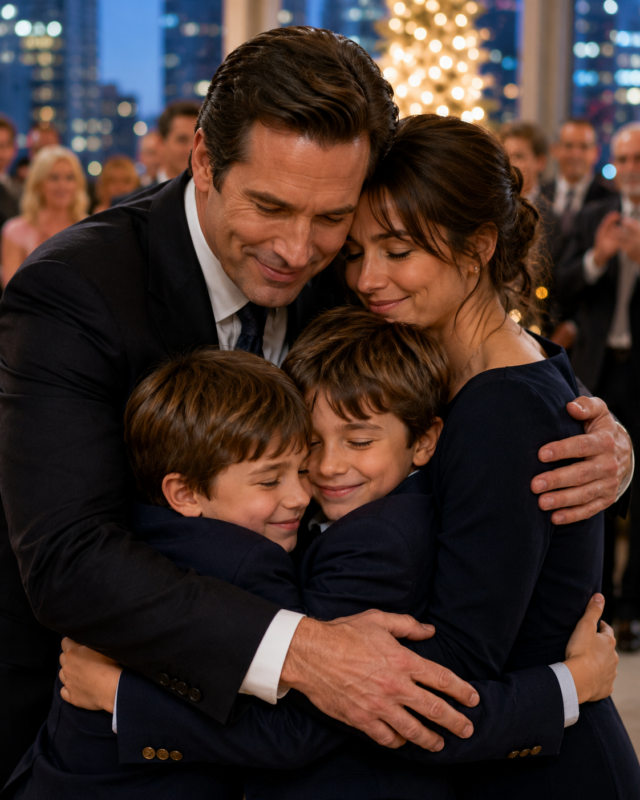
Oliver and Owen wore matching navy sweaters. Emma wore a simple blue dress she had found on sale. Nathan thought she looked more beautiful than anyone in the room.
Margaret was there too.
She stood at a distance, watching the twins with tears she was too proud to wipe away.
Emma noticed her and immediately stiffened.
Nathan stepped closer. “You don’t have to speak to her.”
But Margaret approached slowly.
For once, she did not look like a queen.
She looked like an old woman facing the damage she had caused.
“Emma,” Margaret said, her voice trembling, “I was cruel to you. I thought I was protecting my son, but I was protecting my pride. I stole years from all of you.”
Emma said nothing.
Margaret looked at the boys.
“I don’t deserve to be their grandmother. But if one day you allow me even a small chance to prove I can be kind, I will be grateful.”
Emma’s eyes filled with emotion, but her voice stayed steady.
“I can’t promise anything tonight.”
Margaret nodded.
“That is more than I deserve.”
It was not forgiveness.
But it was the first honest moment between them.
Not a King, Just a Father
Later that evening, Nathan stood on stage to announce the project’s new name.
Behind him was a large image of the neighborhood: the bakery, the laundromat, the park, the old brick buildings, and the families who had nearly been erased by a wealthy man’s ambition.
Nathan looked at Emma and the boys in the front row.
Then he stepped to the microphone.
“For years, people called me the King of Concrete,” he said. “I used to think that meant I had built something great.”
The room went quiet.
“But concrete is only strong when it has a foundation. And somewhere along the way, I forgot mine.”
His eyes found Emma’s.
“I forgot kindness. I forgot responsibility. I forgot the woman who believed in me when I had nothing. And I almost missed the chance to know the two little boys who have changed my life.”
Emma’s lips trembled.
Nathan continued.
“This project will not be called Harrison Crown or Waterfront Empire. It will be called Parker House Community, in honor of Emma Parker and every parent who has counted coins, skipped meals, and still found a way to make their children feel loved.”
The room erupted in applause.
Emma covered her mouth.
Oliver whispered loudly, “Mom, that’s your name!”
Owen added, “Does that mean our house is famous?”
Emma laughed through tears.
Nathan stepped down from the stage.
He did not care about cameras. He did not care about investors. He did not care that half the room now saw him as changed and the other half still thought him foolish.
He walked straight to his sons.
Oliver hugged his leg first.
Owen looked up at him with serious gray eyes.
“Are you going to stay this time?” the boy asked.
Nathan knelt, his throat tight.
“Yes,” he whispered. “As long as you’ll let me.”
Owen studied him for a moment, then wrapped his small arms around Nathan’s neck.
Emma watched them, tears slipping down her face.
Nathan looked up at her.
“I’m sorry,” he said.
Not the kind of apology meant to end a conversation.
The kind meant to begin a lifetime of making things right.
Emma nodded slowly.
“We’ll see,” she whispered.
And somehow, those two words felt like hope.
A New Foundation
One year later, the old neighborhood had not been erased.
It had been renewed.
Russo’s Bakery had a new sign, new ovens, and a line out the door every Friday. The laundromat below Emma’s apartment had been repaired and repainted. Families moved into clean, affordable housing. A playground stood where an empty lot once collected trash.
Nathan still worked hard, but he no longer worshiped work.
On Saturday mornings, he took Oliver and Owen to the planetarium. On Sundays, he helped Emma carry groceries upstairs. Sometimes they argued. Sometimes old wounds reopened. But this time, Nathan did not walk away.
He listened.
He stayed.
Trust returned slowly, like sunlight filtering through a curtain.
One spring afternoon, Nathan, Emma, and the boys sat in the park near the new community center.
Oliver chased bubbles across the grass. Owen lay on a blanket, drawing rockets in his notebook.
Emma looked at Nathan.
“Do you ever regret walking away from that deal?”
Nathan watched his sons laughing under the open sky.
“No.”
“You lost a lot of money.”
He smiled faintly.
“I found something better.”
Emma looked away, but he caught the small smile she tried to hide.
Nathan reached into his coat pocket and pulled out an old coin.
Emma recognized it immediately.
One of the coins she had counted that day in the bakery. Mr. Russo had given it to Nathan later, after Nathan told him the truth.
“I keep it with me,” Nathan said.
“Why?”
“To remember the day I saw clearly.”
Emma’s expression softened.
Nathan looked at the neighborhood he had almost erased—and the family he had almost lost.
Once, he had wanted to be a king.
Now he was learning to be something far greater.
A father.
A protector.
A man finally building something that could not be measured in concrete, steel, or money.