**Part 1 — The “Hair” in the Exhaust**
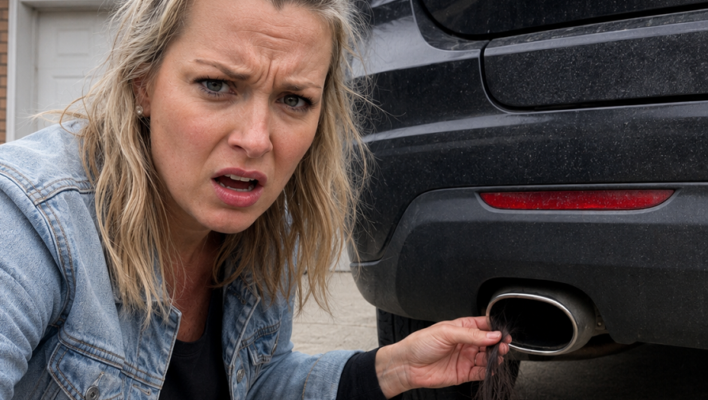
At 7:14 on a Tuesday morning, I stood at the end of our driveway holding what looked like three feet of long black hair.
It had been hanging from my husband’s exhaust pipe.
For months, I had been trying to convince myself that the uneasy feeling in my stomach meant nothing.

Ben had been coming home later than usual.
He had taken calls in rooms where he normally didn’t care who could hear him.
On Saturdays, simple errands somehow stretched into hours.
Whenever I asked questions, he always had an explanation.
Traffic.
Work.
A stop at the store.
Helping his brother.
Nothing dramatic enough to accuse him of anything.
But standing there with those black strands wrapped around my hand, every small inconsistency suddenly connected in my mind.
Ben came outside carrying his coffee.
The moment he saw what I was holding, he stopped.
“Whose hair is this?”
He didn’t answer immediately.
That tiny pause made my heart pound harder.
Then, very quietly, he said, “Laura, you don’t understand what you’re looking at.”
My anger sharpened.
“What exactly is that supposed to mean?”
He walked closer, staring at the strands in my fist.
Then he reached for them.
I pulled my hand away.
“No. First tell me whose they are.”
“They aren’t anyone’s.”
“Ben.”
“I’m serious. It isn’t hair.”
He pinched the end of one strand and stretched it between his fingers. It pulled slightly before separating.
“It’s fiberglass.”
I stared at him.
“What?”
“Muffler packing.”
For a second, I honestly thought he had invented the most ridiculous excuse any unfaithful husband had ever attempted.
“You expect me to believe a muffler grows hair?”
His face didn’t change.
“When the material inside an old muffler starts breaking apart, it can come through the exhaust. The soot turns it black. It looks exactly like hair.”
I looked at the dirty bundle hanging from my hand.
“That’s convenient.”
“I’ll show you.”
He went into the garage and returned with a flashlight.
Just then, our six-year-old daughter, Sophie, appeared in the kitchen doorway.
“Mom! Did you find my purple water bottle?”
“Not right now, sweetheart.”
“But I need the purple one.”
“Use the blue one today.”
Her face suggested that I had just destroyed her entire childhood.
She disappeared back inside.
Ben crouched behind the car and aimed the flashlight into the exhaust pipe.
“Look.”
I bent down.
There were more fibers inside.
Black.
Stringy.
Clearly attached to nothing human.
My imagined brunette disappeared instantly.
I should have felt foolish.
Or relieved.
Instead, I noticed something else.
Ben had known exactly what it was.
No confusion.
No surprise.
He had recognized it immediately.
I stood.
“How did you know?”
His shoulders tightened.
“I’ve been having trouble with the car.”
“What kind of trouble?”
“Nothing you needed to worry about.”
There it was.
That phrase.
Nothing you needed to worry about.
I had heard versions of it before, and I was beginning to hate it.
“Where did you take the car?”
He hesitated.
“Mike’s.”
Mike owned a repair shop about fifteen minutes from us. We had used him before.
“When?”
“Saturday.”
Saturday.
The four-hour shopping trip.
“You told me you were running errands.”
“I know.”
“So why lie?”
“I didn’t want you worrying.”
I crossed my arms.
“What’s wrong with the car?”
“The muffler is going. The brakes will need work soon. And Mike thinks the transmission is starting to slip.”
“How much?”
Ben looked away.
“How much, Ben?”
“Probably more than the car is worth.”
I exhaled.
“Fine. Then we start looking for another one.”
“No.”
I blinked.
“No?”
“We can’t buy another car.”
Something in the way he said it changed the entire morning.
The strange hair was no longer the real problem.
“Why not?”
Ben stared toward the kitchen window.
Inside, Sophie was now pulling dishes from the dishwasher, apparently searching for something that had absolutely no reason to be in the dishwasher.
When Ben finally turned back to me, his face carried an expression I had rarely seen on him.
Not guilt.
Not fear.
Shame.
“We need to talk.”
My stomach tightened.
I asked the question I had been afraid to ask.
“Are you seeing someone?”
“No.”
“Then tell me what’s going on.”
He shut his eyes.
And said the words that made the woman I had imagined seem almost preferable.
“I lost my job.”
**Part 2 — Four Months of Pretending**
I stared at him.
“What?”
“I don’t work at Halpern anymore.”
I almost laughed because the statement was so completely incompatible with the life I had been watching.
“When did this happen?”
He swallowed.
“January.”
It was April.
“No.”
“I’m sorry.”
“You went to work yesterday.”
“I know.”
“You put on a shirt and tie at seven-thirty yesterday morning.”
“I know.”
“You packed lunch.”
“I know.”
“You complained about traffic when you got home.”
His eyes dropped.
“I know.”
I felt cold despite the warm morning.
“Where have you been going every day?”
“The library. Coffee shops. Job interviews when I get them. Sometimes I sit in the car and apply for positions.”
I stared at the man I had slept beside every night.
For nearly four months, he had been waking up, showering, dressing for work, kissing me goodbye and walking out the door as if nothing had changed.
Then he had come home at the usual time and continued the performance.
“You’ve been unemployed for almost four months?”
“Yes.”
“Why wouldn’t you tell me?”
“At first, I thought it would only be temporary. I thought I’d find something in a couple of weeks.”
“And when a couple of weeks became two months?”
“I kept getting interviews. I kept thinking the next one would be it.”
“Ben…”
“I was embarrassed.”
The black fiberglass slipped from my fingers and landed on the driveway.
An hour earlier, I had believed betrayal would mean another woman.
Oddly, that version had seemed easier to understand.
There would have been a person to hate.
A clear line that had been crossed.
But this?
This meant my husband had been acting out our ordinary life every morning while I had no idea the foundation beneath us had already shifted.
“We have a mortgage,” I said.
“I know.”
“We have a child.”
“I know.”
“We have insurance. Utilities. Groceries. Everything.”
“I’ve been taking care of it.”
Something about that sentence terrified me more than anything else he had said.
“How?”
He glanced toward the house.
“Can we get Sophie to school first?”
“No.”
“Laura—”
“How have you been paying our bills?”
He didn’t answer.
And I suddenly understood there was another layer.
I walked into the house.
“Laura.”
I ignored him.
Sophie was standing next to the toaster with her backpack already on.
She held up her purple water bottle triumphantly.
“I found it!”
“Good job, honey.”
She smiled, then studied my face.
“Are you mad?”
“Not at you.”
Ben entered behind me.
I opened my laptop.
“Please,” he said quietly. “Not in front of Sophie.”
For the first time that morning, we agreed on something.
I helped Sophie with her shoes and kissed her goodbye.
Ben drove her to school because my hands were shaking too badly to trust myself behind the wheel.
At 7:42, he returned.
I was sitting at the kitchen table.
Our bank account was open on the screen.
The emergency fund we had spent years building was almost gone.
Once, there had been $24,600.
Now there was $3,114.
I turned the laptop toward him.
“Where did more than twenty-one thousand dollars go?”
He sat across from me.
“Mortgage payments. Utilities. Insurance. Groceries.”
“That doesn’t explain all of it.”
“And the credit cards.”
I stopped breathing for a second.
“What credit cards?”
His silence was answer enough.
“What cards, Ben?”
“I opened two.”
“In your name?”
A pause.
One second.
Maybe less.
But I knew.
I stood so quickly the chair scraped against the floor.
“Whose name is on them?”
“Ours.”
I felt my mouth go dry.
“I never applied for a credit card.”
“I know.”
“Did you use my information?”
“The applications required household information.”
“That’s not what I asked.”
He stared at the table.
“Did you sign my name?”
“They were online.”
“Did you authorize them as me?”
He said nothing.
And in that silence, something inside me cracked.
**Part 3 — 8:03 A.M.**
I looked down at my left hand.
Then I removed my wedding ring.
Ben’s face changed immediately.
“Laura…”
I placed the ring on the counter beside the toaster.
The oven clock read 8:03.
Forty-nine minutes earlier, I had believed another woman’s hair was hanging from his car.
At that moment, I almost wished I had been right.
At least I would have understood that kind of betrayal.
“How much?”
Ben rubbed his palms against his jeans.
“About eighteen.”
“Eighteen hundred?”
His face told me before he spoke.
“Thousand.”
I stared at him.
“So you emptied more than twenty-one thousand dollars from our savings and then added eighteen thousand dollars in credit card debt?”
“I’m interviewing. I’m trying—”
“That isn’t what I asked.”
“I know.”
“Is there anything else?”
He covered his face with both hands.
My stomach dropped.
“There is.”
“I borrowed against my retirement account.”
“How much?”
“Twelve thousand.”
I sat down.
At some point, the numbers stopped feeling real.
Twenty-one thousand.
Eighteen thousand.
Twelve thousand.
They became abstract figures floating around the kitchen while my wedding ring sat beside a toaster full of crumbs.
“Why would you do this?”
“I wanted to keep everything normal.”
“For who?”
“For you and Sophie.”
I shook my head.
“No.”
He looked at me.
“You weren’t keeping things normal for us. You were keeping them normal for yourself.”
“That’s not fair.”
I almost couldn’t believe he had said it.
“Not fair?”
“I was trying to protect this family.”
“You lied to me every morning for almost four months.”
“I thought I could solve it before you ever had to know.”
“You used my identity to open debt.”
“I knew you would panic.”
The room went completely still.
Of everything he had said that morning, those five words hurt the most.
“You knew I would panic?”
“That came out wrong.”
“No. I think it came out exactly the way you meant it.”
“Laura—”
“You decided you were entitled to remove me from decisions about my own life because you were afraid of how I might react.”
“That wasn’t my intention.”
“Then what was?”
He opened his mouth.
Nothing came out.
Tears started running down my face.
I wasn’t sobbing.
There was no dramatic collapse.
I just sat there crying while staring at a man I suddenly wasn’t sure I knew.
Then Ben began crying too.
He reached across the table.
I moved my hand away.
“Don’t.”
He pulled back.
After a long silence, I asked another question.
“Why did you lose the job?”
He froze.
And immediately I knew.
There was still more.
“You said you lost it. Were you laid off?”
He stared at his hands.
“Technically, I was terminated.”
My stomach turned.
“For what?”
Ben had been an operations manager at a regional distribution company. For years, I had listened to his complaints about the pressure his department was under.
Long shifts.
Impossible targets.
Employees working short-staffed.
Managers threatening people over productivity numbers.
During the holiday season, several members of Ben’s team became ill. The department fell behind badly.
Corporate management warned that employees could be fired if performance didn’t improve.
So Ben changed several reports before sending them upstairs.
I stared at him.
“You changed company records?”
“I adjusted the productivity numbers.”
“To make your team look better?”
“Yes.”
“Why?”
“Because they were going to fire people. People with families. People who had worked there for years.”
“And someone found out.”
He nodded.
“They fired me.”
I leaned back.
He looked destroyed.
Not because he didn’t understand what he had done.
Because he did.
“Why didn’t you tell me any of this?”
“I knew what you would think.”
“What?”
“That I was stupid.”
I shook my head.
“No.”
“That I ruined everything.”
“I would have told you that you made a serious mistake.”
He gave a bitter little laugh.
“That’s the same thing.”
“No, Ben. It isn’t.”
That seemed to stop him.
A person can make a terrible decision without being a terrible person.
But apparently somewhere inside my husband, those two ideas had become indistinguishable.

**Part 4 — Everyone Knew Except Me**
I walked to the window.
Suddenly, memories from the previous months began rearranging themselves.
Ben had come home with stories from work.
A loading dock that broke.
A supervisor who annoyed everyone.
A meeting about dress codes that he claimed lasted nearly an hour.
I turned back toward him.
“Those stories you told me…”
He looked embarrassed.
“Some were things that had happened before.”
I stared.
“You recycled old work stories so I wouldn’t realize you weren’t working?”
“I didn’t know what else to say when you asked about my day.”
For some reason, that almost made me laugh.
It was absurd.
So elaborate.
So painfully sad.
“You spent months pretending to have annoying meetings.”
“I know.”
“Stop saying that.”
He flinched.
“I’m sorry.”
“Stop saying that too.”
He went silent.
“Sorry is what you say when you forget to buy milk. I needed honesty in January.”
For several seconds, neither of us spoke.
Then another thought occurred to me.
“Who else knows?”
His expression changed.
Of course.
There was an answer.
“Who?”
“Jason.”
His brother.
I closed my eyes.
“Since when?”
“February.”
“And your mother?”
“She didn’t know everything.”
“That means she knew something.”
“She knew I wasn’t working.”
A strange laugh escaped me.
His brother knew.
His mother knew.
The man at the repair shop probably knew more about our actual financial condition than I did.
Everyone had been allowed pieces of the truth except the person sharing Ben’s mortgage, raising his child and carrying debt he had created in her name.
I picked up my phone.
“Who are you calling?”
“My mother.”
His face fell.
I didn’t care.
She answered in her usual cheerful voice.
“Hi, sweetheart.”
The second I heard her, I started crying again.
Forty minutes later, she was sitting in our kitchen.
Ben packed a bag.
I asked him to stay with Jason.
He didn’t argue.
That mattered, though not nearly enough.
Before he left, he stopped beside the counter.
My wedding ring was still beside the toaster.
He looked at it for a long moment.
Then he looked at me.
“Is this over?”
I followed his gaze toward the ring.
“I don’t know.”
It wasn’t punishment.
It wasn’t a threat.
It was simply the truth.
He nodded.
Picked up his bag.
And left.
**Part 5 — The Damage I Couldn’t See**
The next week was one of the most exhausting of my life.
There was no dramatic public humiliation.
No neighborhood scandal.
No shouting match in front of friends.
Just paperwork.
Hours and hours of paperwork.
I went through every account I had once believed I understood.
I pulled my credit report.
The two cards were there.
So was a missed payment I hadn’t known about.
Ben had changed the notification email so the warning messages wouldn’t reach me.
That discovery hurt almost as much as the debt itself.
It wasn’t simply that he had hidden a problem.
He had built systems to make sure I remained unaware of it.
I contacted our bank.
The mortgage company.
Our insurer.
A financial counselor.
Eventually, a lawyer.
I needed to understand exactly what had happened and what responsibility I had for debts created using my information.
Ben gave me everything I asked for.
Passwords.
Statements.
Emails.
Job applications.
Retirement account records.
He didn’t hide anything else.
He didn’t become defensive.
He didn’t try to stop me from checking.
That mattered.
It didn’t erase what he had done.
But it mattered.
And the ridiculous “hair” that had started all of this?
Mike confirmed Ben had been telling the truth about that part.
When I took the car to his shop, he pulled a similar piece of material from another damaged muffler.
“You’d be amazed how many people think this stuff is hair,” he said.
I looked at the filthy strands in his hand.
Then I started laughing.
A few seconds later, I was crying.
Poor Mike stood beside the car holding dirty fiberglass with the expression of a man deeply regretting his involvement in someone else’s marriage.
Ben and I remained separated for three months.
Six weeks after leaving our house, he accepted another job.
The salary was lower.
The commute was longer.
It wasn’t the position he wanted.
But he took it.
He also began therapy.
At first, I assumed therapy would be about losing his job.
It turned out that losing the job was only the trigger.
The deeper problem had been there long before January.
Ben’s father had lost their family home when Ben was thirteen.
I had always known his family had gone through financial hardship.
What I didn’t know was how it happened.
His father had hidden overdue bills from his mother.
He pretended their finances were fine.
He reassured everyone while quietly falling further behind.
For nearly a year, Ben had watched his father perform normal life while disaster grew behind closed doors.
When Ben finally told me the full story, I stared at him.
“You did exactly what your father did.”
He broke down.
“I know.”
That realization seemed to reach someplace inside him that all my anger hadn’t.
Ben had spent most of his adult life telling himself he would never become his father.
He would be dependable.
Responsible.
The man who protected his family.
But somewhere along the way, he had absorbed his father’s worst lesson:
A good provider never admits he’s failing.
So when Ben lost his job and felt ashamed, he followed the same script.
Hide the bills.
Hide the fear.
Pretend everything is fine.
Keep smiling until you can fix it.
Except he couldn’t fix it.
And every attempt to conceal the original problem created a larger one.
His childhood explained his behavior.
It did not excuse it.
That distinction became important to both of us.

**Part 6 — Trying Again Without Pretending**
Eventually, Ben and I started marriage counseling.
For months, my wedding ring remained in a small jewelry box in my bedroom.
Ben never asked me to put it back on.
That helped more than he probably realized.
I needed the choice to belong to me.
We created rules.
No secret accounts.
No new debt unless we both agreed to it.
Regular credit checks.
Complete access to financial records until trust was rebuilt.
No moving money between accounts without discussion.
Ben agreed to all of it.
Then I gave him one rule that had nothing to do with money.
“If something terrible happens,” I said, “you tell me before you try to protect me from it.”
He nodded.
“No deciding what I can handle.”
“Okay.”
“No pretending everything is fine because you’re ashamed.”
“Okay.”
“And absolutely no fake stories about meetings at work.”
For the first time in a long while, he almost smiled.
“Definitely no fake work stories.”
Eight months after that Tuesday morning, I opened the jewelry box.
I stared at my ring for several minutes.
Then I put it back on.
Not because everything had been repaired.
It hadn’t.
Trust doesn’t return because someone apologizes enough times.
It returns through hundreds of small moments when a person has the opportunity to hide something and chooses not to.
I put the ring back on because I had decided I still wanted to try.
There is a difference between forgiveness and pretending nothing happened.
There is also a difference between reconciliation and forgetting.
We are still rebuilding the emergency fund.
The old car is gone.
Mike bought it for parts.
Sometimes I joke that the muffler saved our marriage.
Ben always tells me that’s an extremely generous interpretation.
He’s probably right.
The muffler didn’t save us.
It simply exposed us.
**Part 7 — What I Thought Betrayal Looked Like**
At 7:14 that Tuesday morning, I believed I was holding proof that my husband had been with another woman.
I wasn’t.
I was holding filthy fiberglass from a dying exhaust system.
But my instincts hadn’t been completely wrong.
Something had been wrong.
I had noticed it for months.
The strange errands.
The late arrivals.
The private calls.
The vague explanations.
That feeling that the story I was being told didn’t quite fit the life happening in front of me.
There was no mysterious brunette.
There was something I had never considered instead.
A husband so terrified of appearing to be a failure that he transformed our marriage into a performance and convinced himself he was doing it out of love.
For years, I thought betrayal required another person.
I thought it meant an affair.
Secret messages.
A hotel room.
Someone else occupying the space that belonged to your marriage.
Now I understand that betrayal can look very different.
Sometimes betrayal is being denied access to your own reality.
Ben losing his job was frightening, but we could have faced it together.
His decision at work was serious, but we could have talked through the consequences.
The lost savings were painful.
The debt was worse.
Using my information on credit applications crossed a line that took a long time to process.
But underneath all of those things was the wound that nearly ended our marriage:
Ben had decided I couldn’t be trusted with the truth.
He had decided fear gave him the right to make choices for both of us.
Today, our marriage works differently.
If the dishwasher starts leaking, we say it.
If a bill arrives and it is higher than expected, we say it.
If something happens at work that scares him, he tells me.
When his company once announced possible layoffs, he came home that same evening and told me before he had even changed out of his work clothes.
He was scared.
So was I.
We talked anyway.
Because that Tuesday morning taught both of us an extraordinarily expensive lesson.
You cannot protect a marriage by hiding the problem threatening it.
All you do is postpone the moment your spouse discovers the disaster—and make sure they face that discovery alone.
I still have the photograph I took that morning.
Every once in a while, my phone brings it back in old memories.
Three feet of dirty black fibers hanging from Ben’s exhaust pipe.
The evidence of an affair that never existed.
I always stare at it longer than I expect to.
Because in a strange way, it really was evidence.
Not of another woman.
Not of infidelity.
But of a life that had started coming apart while I was still being told everything was fine.
And somehow, those ridiculous black strands hanging from a broken muffler became the clue that finally pulled the truth into the light.