At 6:00 in the morning, the wooden floorboards trembled beneath my feet.
A heavy, furious blow rolled down the hallway, followed by a deafening crack of splintering wood.
I stood in the dim light of my living room, with a steady pulse and a cup of slightly warm black coffee in my hands.
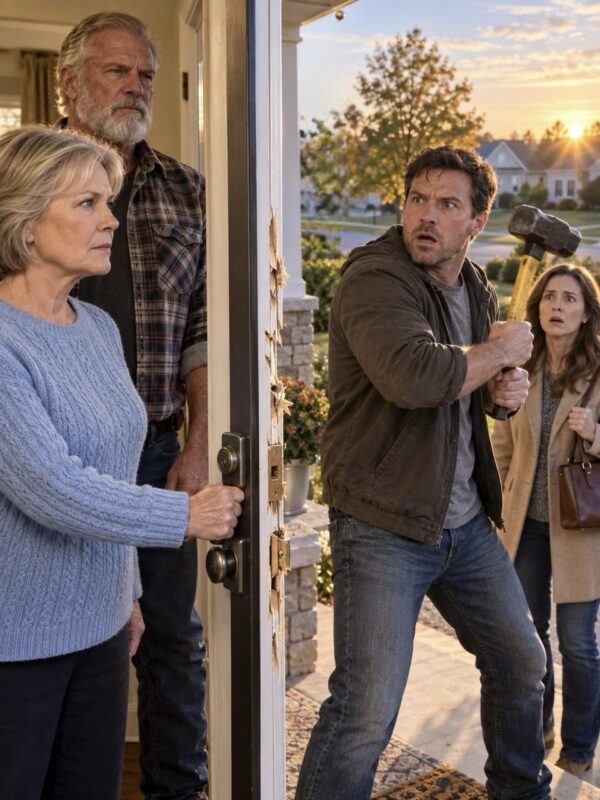
It was the sound of my own son trying to break down my front door.
But to understand how a sledgehammer became the only way David could communicate with me, we need to go back three months.
That was when I made the mistake of opening the door to him and his wife, Sarah.
They stood on my porch in the pouring rain, dragging three enormous suitcases behind them.
Their apartment lease had ended, and their new place wouldn’t be ready for a few more weeks.
David looked exhausted.
Sarah looked annoyed and was scrolling through something on her phone, not even saying hello.
My name is Lisa Barrett.
I’ve lived in this house for 30 years.
I know every creak of the stairs and every draft from the windows.
This is where I raised David after his father died.
I didn’t hesitate and let them in, assuming it was just a temporary rough patch in their lives.
The first changes came on the third day.
I walked into the kitchen to make my morning coffee and discovered that my vintage espresso machine had been pushed into a dark corner of the pantry.
In its place stood a shiny, enormous smart blender.
Sarah was leaning against the counter, drinking a green smoothie.
“Everything was arranged completely inconveniently for you, Lisa.
I rearranged everything so the things we actually use are in front.”
I didn’t argue.
I didn’t raise my voice or lecture her about respect.
I simply walked over to the pantry, lifted her heavy blender, and set it on the floor.
Then I returned my espresso machine to its rightful place, plugged it in, and turned it on.
Sarah clenched her jaw.
“I was just trying to help.”
“I didn’t ask for help,” I replied, taking my favorite mug from the cabinet.
She stormed off angrily.
I took a sip of coffee, understanding that this was only the beginning.
By the end of the second week, the story about “a few weeks” had quietly disappeared.
No one mentioned looking for an apartment anymore.
Instead, David and Sarah settled in like permanent residents who had just inherited a fully serviced boutique hotel.
The real test of boundaries began in the hallway.
I found an enormous woven basket filled to the brim with their dirty laundry, right in front of the laundry room door.
On top lay a sticky note written in Sarah’s elaborate handwriting.
“Whites in warm water, darks in cold.
Please use organic detergent.”
I stared at the note.
I hadn’t done David’s laundry since he was 17, and I certainly wasn’t about to start washing his wife’s yoga leggings.
I didn’t get angry.
Anger is a waste of energy.
I lifted the heavy basket, carried it straight upstairs, and dumped the entire contents in the middle of their mattress.
I left the note stuck to David’s favorite jacket.
That evening, heavy footsteps thundered down the stairs.
David appeared in the kitchen, rubbing the back of his neck and clearly uncomfortable.
“Mom, Sarah is really upset,” he said.
“You threw our laundry on the bed.
We both work late.
We just thought you wouldn’t mind throwing in one load, since you’re home anyway.”
I was cutting carrots, and the knife tapped sharply and rhythmically against the cutting board.
“I do mind,” I replied without looking up.
“It’s just one load,” he muttered, slipping back into that whining tone he used as a teenager.
I put down the knife and finally looked at him.
“You have two hands, David.
The washing machine has three buttons.
Figure it out or take your things to the laundromat.
This is a home, not a hotel.”
He opened his mouth to argue, but saw the look in my eyes and closed it.
He went upstairs.
But the next morning I noticed something else.
The spare keys I kept on the hook by the back door were gone.
They were starting to feel far too comfortable here.
The situation deteriorated gradually and imperceptibly.
When someone wants to take over your space, they usually don’t declare war.
They just start erasing you centimeter by centimeter.
On Tuesday afternoon, I returned from the garden center and found the hallway completely empty.
The antique oak console table that my late husband had restored with his own hands was gone.
The framed family photographs that had stood on it were carelessly piled on a kitchen chair.
Sarah was sitting on the couch, typing rapidly on her laptop.
“Where’s the table?” I asked, setting my keys on the counter.
She didn’t even look up.
“Oh, I put it out by the road.
That bulky wooden thing was ruining the look of the entryway.
I ordered an elegant metal table from Amazon.
It fits our style much better.”
My heart clenched, but I didn’t let her see that I was losing my composure.
I didn’t scream.
I didn’t cry over the memory of my late husband.
I simply walked out the front door.
The table was standing on the grass.
I dragged it back up the steps, brought it through the front door, and put it back in its place.
Sarah finally looked up, her eyes wide.
“What are you doing?
The garbage truck comes in an hour.”
“Never touch my furniture again,” I said in a completely calm voice.
“We live here too,” she snapped, slamming her laptop shut.
“We should have a say in how the house looks.”
“Guests,” I corrected her.
I gathered the photographs and took them to my bedroom.
That same day, I drove to the hardware store.
I didn’t buy a flimsy interior door lock.
I bought a reinforced door bolt.
By dinner, I had installed it on my bedroom door.
When I went to bed that night, I turned the massive metal lock and heard a satisfying click.
If they were going to treat my home like a playground, I was going to turn my room into a fortress.
Soon after the furniture incident, the financial demands began.
On Friday, the mail came, and I opened the monthly internet and cable bill.
The amount had skyrocketed.
Someone had switched the plan to the most expensive tier, added premium sports packages, and purchased three pay-per-view movies.
I walked into the living room.
David was sprawled on the couch playing an online game.
“David.”
I held up the bill.
“Care to explain why my internet bill tripled?”
He didn’t pause the game.
“Oh, yeah.
The Wi-Fi was too slow for Sarah’s remote work meetings, and I needed better ping for gaming.
I just called the company and upgraded the plan.
Much faster now, right?”
“You unilaterally changed the settings on an account that’s in my name?”
“Mom, relax.
We need it.
It’s no big deal.”
I didn’t waste time arguing.
I went straight to my office, picked up the phone, and called the provider.
I didn’t ask to downgrade the plan.
I canceled the service entirely, effective immediately.
Ten minutes later, the video game on the TV froze.
David groaned in frustration, pressing buttons on the controller.
Sarah burst out of the kitchen, holding her phone up.
“Did the router break?” she demanded.
“I have a deadline.”
I came out of the office, my reading glasses lowered to the tip of my nose.
“The router works.
The service is disconnected.”
David dropped the controller.
“What?
Why would you do that?”
“Because I don’t pay for things I didn’t authorize,” I replied calmly.
“If you need premium internet, call the company, open an account in your name, and pay with your credit card.”
Sarah’s face turned bright red.
“You’re being completely unreasonable.
How are we supposed to live without Wi-Fi?”
“You have mobile data on your phones,” I suggested with a slight, polite smile.
“Or there’s a coffee shop three blocks from here.”
I turned, walked into my bedroom, and locked the bolt.
Let them use up their own mobile data.
The lack of internet didn’t make them move out.
It only made them more bitter.
A cold war settled over the house.
They stopped talking to me and treated me like an annoying roommate they were forced to tolerate.
One warm evening, I was sitting on the dimly lit porch, enjoying the cool breeze.
Behind me, the kitchen window was open.
I heard the clink of wine glasses, then the quiet, muffled voices of David and Sarah.
I sat completely still in the wicker chair.
“I can’t do this anymore,” Sarah hissed.
“She’s unbearable.
She treats us like children.”
“Just be patient,” David murmured.
“We’re saving so much money by not paying rent.”
“We need to think long-term, Dave,” Sarah insisted in a sharp, calculating voice.
“Look at her.
She’s getting forgetful.
She locks herself in her room like a paranoid recluse.
If we document that kind of behavior, we can easily find a doctor who’ll confirm she needs full-time care.”
“A nursing home?” David asked hesitantly.
“A good one,” Sarah insisted.
“She’ll have friends, and we’ll have the house.
We can finally renovate that old-fashioned kitchen and make this place our own.
It’s going to be yours someday anyway.
Why wait ten years if we need it now?”
Silence fell in the kitchen.
I waited for my son to stand up for me.
I waited for him to tell his wife she was out of her mind.
Instead, David sighed.
“First we’ll need to get my name on the house deed or get power of attorney.
If I tell her it’s for tax purposes, maybe she’ll sign.”
I didn’t cry.
I didn’t burst inside and scream at them.
Panic and rage are for people who don’t have a plan.
I stood up silently, went down the porch steps, and walked around the back of the house to enter through my bedroom’s sliding door.
They wanted my house.
They thought I was a fragile old woman who could be pushed aside.
But they were about to find out who they were dealing with.
The next morning, I made one phone call.
I didn’t call a lawyer.
Lawsuits drag on for months and drain your bank account.
I needed immediate and practical reality.
I called Arthur.
Arthur was a retired general contractor.
He was built like a brick wall, had a voice like scraping gravel, and had been my late husband’s best friend.
He knew this house inside and out because he had helped build the addition 20 years ago.
He came over while David and Sarah were at work.
We sat at the kitchen table, and I told him everything I had heard.
Arthur clenched his jaw.
He placed his huge, calloused hands on his coffee mug.
“You want me to throw them out by the scruff of their necks, Lisa?
Just say the word.”
“No,” I said, shaking my head.
“No drama, no physical confrontations.
I just want them gone, and I want to do it so cleanly that they won’t even have time to blink.”
“What’s the timeline?” he asked.
“They mentioned a weekend trip for two to celebrate Sarah’s birthday.
They leave Friday afternoon and return Sunday morning.”
A grim smile slowly spread across Arthur’s face.
“48 hours.
More than enough.
I’ll bring my guys.
We’ll need boxes, heavy-duty packing tape, and three new deadbolts.
Want me to replace the window latches while we’re at it?”
“Do it.”
I nodded.
For the next three days, I watched David and Sarah.
They were overly courteous to me.
David offered to mow the lawn.
Sarah bought me a box of expensive tea.
It was a carefully calculated performance, preparing the ground for the tax documents they were soon going to slip in front of me to sign.
I accepted the tea, thanked David for offering to mow the lawn, and kept a neutral, pleasant mask on my face.
When Friday finally arrived, they loaded their bags into David’s car.
“Have a good weekend, Mom,” David waved.
“Take care of yourself,” I replied.
As soon as their car disappeared around the bend, Arthur’s heavy truck pulled into my driveway.
Arthur hadn’t come alone.
He had brought two grown sons, both built just like him.
They came in through the front door, carrying stacks of flattened cardboard boxes and rolls of industrial packing tape.
“Alright, Lisa,” Arthur said, rolling up the sleeves of his flannel shirt.
“Show us what goes where.”
I pointed upstairs.
“Everything from the guest room, every toothbrush from the bathroom, and all the organic smoothie powder from the pantry.”
We worked with mechanical efficiency.
I didn’t throw anything away.
That would have given them grounds to claim damages.
I simply packed everything.
We folded Sarah’s expensive clothes, packed up David’s gaming console, and wrapped their shoes.
Every trace of their presence was placed into sturdy cardboard boxes and sealed with tape.
By Saturday evening, Arthur’s truck was loaded to the brim.
He drove it to a 24-hour self-storage facility three miles down the road, rented a unit in my name, and stored their entire life there.
Meanwhile, Arthur’s sons worked on my front and back doors.
The old brass locks were removed.
In their place, sturdy steel reinforced deadbolts were installed.
They changed the garage code.
They installed a reinforced strike plate on the front door frame.
By Sunday morning, the house was immaculately clean.
The vintage console table was polished.
My espresso machine hummed quietly in the kitchen.
The guest room was completely empty and smelled faintly of lemon cleaner.
I sat at the kitchen island, drinking coffee and watching the clock approach 6 a.m.
I knew they planned to return early to avoid Sunday traffic.
Arthur sat across from me, sipping his coffee and leaning back in his chair with his arms crossed.
“Are you okay?” he asked quietly.
I took a slow sip of coffee.
“I’ve never felt better.”
Outside, tires crunched on the gravel.
Car doors slammed.
Footsteps approached the porch.
I heard the familiar jingle of David’s keys.
I heard the metal enter the lock, touch the new cylinder, and refuse to turn.
The games were officially over.
I heard the lock click uselessly.
Then came the rattling of the doorknob.
“What the hell?” David’s muffled voice came through the heavy oak door.
“My key doesn’t work.”
“Try the deadbolt, Dave,” Sarah snapped impatiently.
More rattling.
An exasperated sigh, then a heavy fist pounded on the wood.
“Mom, open up.
The lock is stuck.”
I didn’t move.
I took another sip of coffee.
Arthur merely raised an eyebrow.
The knocking grew louder.
“Mom, are you in there?
Open the door.”
When silence answered them, panic turned to anger.
Sarah’s shrill voice cut through the morning air.
“She changed the locks.
I told you she was losing her mind.
David, break the door down.
We need to get inside.”
“Stand back,” David growled.
And then, for the first time, a heavy, furious blow echoed through the house.
The floorboards trembled.
He was hitting the door near the handle.
I knew exactly what he was using: the heavy sledgehammer he kept in his trunk for his weekend landscaping side jobs.
Another blow struck the door, splintering the decorative trim around the doorframe.
My heart didn’t beat faster.
It settled into a cold, hard rhythm.
I stood up and smoothed my sweater.
At 6:00 in the morning, my son had arrived with his wife and a sledgehammer in hand.
I had changed all the locks.
Behind me, a calm voice said, “Let them try.
I’ll handle this.”
Arthur stood up, his massive frame casting a shadow down the hallway.
He didn’t look angry.
He looked like a man about to swat a very annoying fly.
I opened the door, and they both went pale.
I slid the bolt back and yanked the heavy door open inward just as David was raising the sledgehammer for a third strike.
He froze mid-swing, breathing hard, his face red with rage.
Sarah stood behind him, clutching her purse tightly.
The smug expression of self-righteousness vanished from her face the second she saw us.
David slowly lowered the sledgehammer, his gaze shifting from me to the still, massive figure of Arthur.
“What’s going on here?” David demanded, trying to sound authoritative, but his voice cracked.
“Why won’t you let us in?
What is Arthur doing here?”
I didn’t answer his questions.
I reached into my pocket and pulled out a small silver key on a plastic tag along with a folded piece of paper.
I held them out to him.
“What is this?” Sarah asked, refusing to come closer.
“That’s the key to unit number 402 at the secure storage facility on Route 9,” I said clearly.
“The paper has the gate code and the receipt for the first month’s rent.
All of your belongings are there.
You don’t live here anymore.”
David stared at the key as if it were a live grenade.
“You… you packed our things.
Mom, you can’t do this.
We live here.
We have rights.”
“You’re guests who overstayed your welcome,” I corrected him.
“And you forfeited your privileges the night you sat on my patio planning to send me to a nursing home so you could steal my house.”
Sarah gasped and physically took a step back, her face completely drained of color.
David opened and closed his mouth like a fish out of water.
“You heard that,” David whispered.
“I heard every word,” I replied.
“This morning I also removed my credit card from your family mobile phone plan and canceled the car insurance that’s in my name.
You want to be independent adults managing your own household.
Start today.”
Sarah narrowed her eyes.
“You’re insane.
We’ll just force our way in.”
Arthur took exactly one step forward.
His boots landed heavily on the wooden floor.
“You won’t set one foot over that threshold, son.
Want to try that sledgehammer again, Dave?
Let’s see how that ends.”
David looked at Arthur, then at the sledgehammer, and finally at me.
He dropped the tool on the porch.
David reached out with a trembling hand for the storage key and receipt and took them from my fingers.
He didn’t say he was sorry.
He didn’t beg.
The absolute determination in my eyes, backed by Arthur’s silent, towering presence, left no room for negotiation.
Sarah spun on her heels, her face burning with humiliation, and headed back to the car without looking back.
David lingered for a split second, as if hoping to find some magic phrase that could undo everything that had happened that morning.
Finding none, he turned and followed his wife.
I watched their car back out of the driveway and speed down the street.
Arthur bent down, picked up the sledgehammer, and leaned it against the railing.
“I’ll bring the guys by later to fix the doorframe.”
“There’s hardly any damage.
Really.
Thank you, Arthur,” I said, feeling an enormous weight lift from my shoulders.
“Any time, Lisa.”
He nodded and walked to his truck, leaving me alone in the morning air.
I closed the front door and turned the new heavy steel bolt.
The click of the lock was the most beautiful sound I had heard in months.
I returned to the kitchen.
The house was completely mine again.
No more notes dictating what I should do, no more disappearing furniture, no more whispering shadows plotting against me.
There was only the quiet hum of the refrigerator and the smell of fresh coffee.
People think that setting boundaries requires loud scandals, legal threats, or tearful confrontations.
It doesn’t.
Sometimes the strongest thing you can do is refuse to be a victim, pack up the disrespect into boxes, and change the locks.
I sat at the kitchen island, picked up my favorite mug, and took a sip.
For the first time in a long time, the coffee tasted perfect to me.
If this whole story taught me anything, it’s that peace isn’t something you can simply wish for.
It’s something you have to protect.
We spend our whole lives caring for our children, hoping we raised them well.
But sometimes the most necessary thing you can do for yourself is draw a clear line.
You don’t need shouting and scandals, and you absolutely don’t need to wait for someone’s permission to be treated with respect.
Sometimes reclaiming your power is as quiet and simple as changing a lock and refusing to be a guest in your own life.
It’s never too late to stand up for your boundaries.
If my story touched you, or if you’ve ever had to make a difficult decision for your own peace of mind, I’d love to hear your thoughts in the comments below.
Please give it a like and don’t forget to subscribe to the channel to see more stories about setting boundaries and staying strong.
Until next time — take care of yourself.